Engineering Intelligence
Port's Engineering Intelligence solution gives engineering leaders a unified, data-driven view of how their teams build and deliver software, connecting metrics, standards, and AI-powered insights on a single platform.
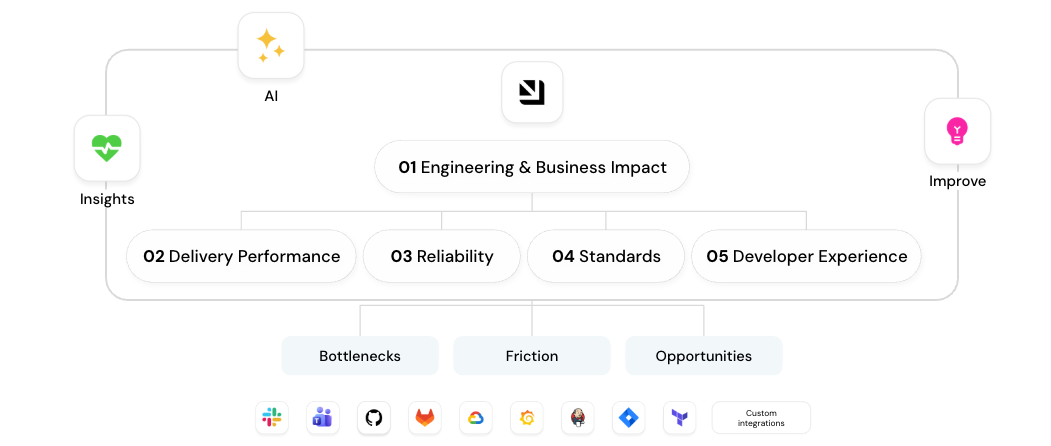
What is Engineering Intelligence?
Engineering Intelligence is the practice of measuring, understanding, and continuously improving engineering effectiveness. Instead of relying on gut feelings or fragmented dashboards, teams use connected data from across their toolchain to answer critical questions:
- Where are the bottlenecks?: Identify which stages of delivery slow teams down the most.
- What's causing friction?: Surface pain points through developer surveys and correlated metrics.
- Where should we invest?: Focus improvement efforts where they'll have the biggest impact.
Solution components
Port's Engineering Intelligence is organized around five complementary components. Each component covers a broad area, the examples below are starting points, not exhaustive lists:
| Component | Examples |
|---|---|
| Engineering & Business Impact | Engineering velocity including DORA metrics, AI adoption and impact, automations ROI dashboard, business-aligned delivery KPIs, and more. |
| Delivery Performance | PR throughput, PR cycle time, measuring lead time, stale PR tracking, and more. |
| Reliability | CI/CD pipeline health, workflow failure rates, tracking MTTR, incidents, mean time between failures, service stability trends, and more. |
| Standards | Production readiness scorecards, DORA scorecards, pipeline reliability scorecards, code quality gates, security compliance, working agreements, and more. |
| Developer Experience | Developer surveys, sentiment tracking, onboarding feedback, qualitative insights, and more. |
These components are connected through Port's software catalog & context lake, where every metric is linked to the services, teams, and owners it belongs to. AI agents and automation sit on top, surfacing insights and driving action across all five areas.
How Port makes it work
Port combines three capabilities that set it apart from standalone metrics tools:
-
Insights: Metrics and surveys feed into dashboards connected to your live software catalog & context lake. When a metric changes, you see exactly which services and teams are affected.
-
AI Agents: Analyze trends, explain what's driving changes, and recommend concrete next steps grounded in your organization's actual data and context.
-
Improve: Scorecards enforce standards automatically. Workflows create tickets, notify owners, and trigger remediation when metrics degrade closing the loop from insight to action.
Supported data sources
Engineering Intelligence relies on connected data from across your toolchain. The more sources you connect, the richer the context available to dashboards, scorecards, and AI agents, and the more accurately Port can link metrics to the services, teams, and owners they belong to.
| Category | Examples | What it enables |
|---|---|---|
| Version control | GitHub, GitLab, Azure DevOps, Bitbucket | DORA metrics, delivery performance tracking, PR staleness, production readiness scorecards |
| Issue tracking | Jira, Linear, Azure DevOps Boards | Lead time tracking, alignment between engineering output and business priorities |
| Incident management | PagerDuty, OpsGenie, Incident.io | MTTR tracking, MTBF calculations, reliability analysis |
| CI/CD & deployment | GitHub Actions, GitLab CI, Azure Pipelines, ArgoCD | Pipeline reliability scorecards, deployment frequency metrics |
| Observability | Datadog, New Relic, Dynatrace | SLO compliance, service health |
| AI coding tools | GitHub Copilot, Claude, Cursor | AI adoption tracking and ROI analysis |
| Security & code quality | Snyk, SonarQube, Wiz | Security compliance scorecards, production readiness |
| Cloud & infrastructure | AWS, Azure, GCP, Kubernetes | Service dependencies, deployment targets, blast radius analysis |
Don't see your tool? Port's Ocean custom integration framework lets you ingest data from any source. Port's MCP connectors also allow AI agents to query external tools in real time without ingesting data first. For the full list of integrations, see the Port integrations catalog.
Next steps
- Getting started: A phased approach to rolling out Engineering Intelligence in your organization.
- Why Port?: How Port's catalog-first approach differs from standalone metrics tools.