Autonomous ticket resolution
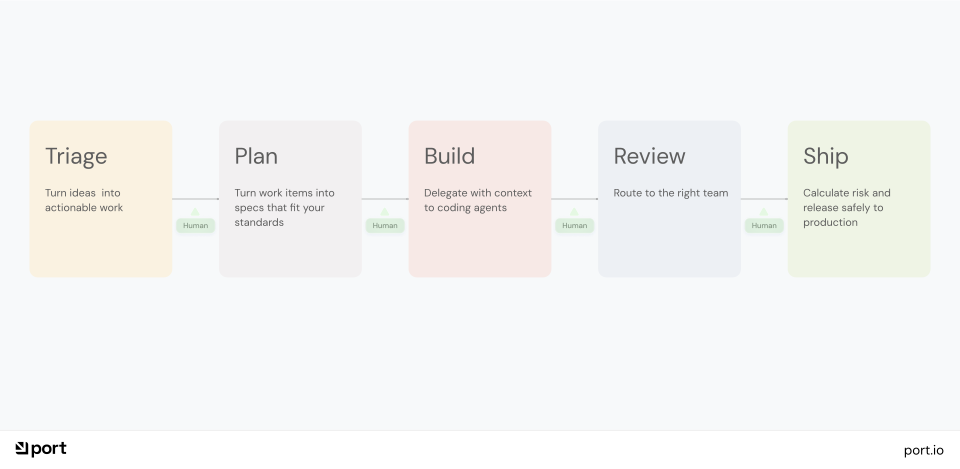
Your SDLC already has stages: triage, plan, build, review, ship. At each one, you decide what AI handles and where a human stays in control. Autonomous Ticket Resolution is Port's pattern for building that system, using your existing tools, your existing catalog, and your own rules for when AI earns the handoff.
Even with AI writing code, the bottleneck is rarely the code. It's the steps before and after: assembling context, routing the work, reviewing risk, approving a deploy. AI can generate roughly 80% of a feature quickly. The remaining 20% (the routing decisions, the edge cases, the context a model doesn't have) is where most delivery stalls.
What breaks without a platform
Software delivery has gone through Waterfall, Agile, and DevOps, each reducing cycle time and each introducing new coordination overhead. AI compresses the cycle further, but unevenly: implementation that once took weeks can now take hours, while requirements, routing, and verification remain stubbornly human-paced. That's the root cause ATR addresses.
Most teams already have good coding tools. The slowdown happens before, around, and after coding.
| Without Port | With Port |
|---|---|
| ❌ Ticket arrives: "Fix login bug" with no service, no owner, no scope. | ✅ Work item arrives enriched: service, owner, blast radius, and context already assembled. |
| ❌ Engineer spends time finding ownership, dependencies, and recent incidents. | ✅ Ownership, dependencies, and incidents pulled from the catalog automatically. |
| ❌ Routing decision made informally ("feels like a small change"). | ✅ Scorecard evaluates blast radius, service tier, and priority deterministically. |
| ❌ Code review starts with no context about what the service does or who owns it. | ✅ PR enriched with catalog context, risk signals, and ownership before review opens. |
| ❌ Deployment happens manually, blast radius assessed after the fact. | ✅ Deployment gates enforce readiness, staged rollout runs automatically. |
| ❌ Nobody knows how many tickets AI handled or where work stalled. | ✅ ROI dashboard tracks agent vs human split, stage breakdowns, and trends. |
Port gives you building blocks for each stage. You decide how far to automate each one, and where humans stay in the loop.
| Stage | What it covers |
|---|---|
| Triage | Turn ideas into actionable work. |
| Plan | Turn work items into specs that fit your standards. |
| Build | Delegate with context to coding agents. Human checkpoint. |
| Review | Route to the right team. Human checkpoint. |
| Ship | Calculate risk and release safely to production. |
How Port makes it work
In an AI-assisted SDLC, the developer's primary output is not code. It's the system that produces code. Every stage in ATR is built from the same three building blocks. You compose them, and Port doesn't prescribe the exact workflow.
- Context lake - AI agents don't fail because the model is wrong. They fail because the context is wrong. Port's software catalog connects tickets to services, teams, repositories, and ownership, giving agents the right context instead of five separate API calls.
- Scorecards - Platform-defined rules gate every transition. Routing, review approval, deployment readiness: all deterministic and auditable.
- Workflows - Orchestrate agents, humans, and tools across each stage. The same workflow infrastructure handles ticket prep today and safe release tomorrow.
Platform teams define the rules. Engineers and agents consume them. Port is the layer that connects the two, so a decision made once by the platform team scales to every ticket.
Customers using Port workflows are already reporting 40-45% of engineering tasks automated and 20%+ improvements in developer productivity.
Next steps
- Getting started with your first workflow - Build an end-to-end ATR workflow: Jira ticket to catalog enrichment, AI readiness scoring, Slack approval, and Cursor delegation.
- Why Port? - What Port adds vs. building this yourself.
- Triage and plan - Enrich, triage, and route tickets using catalog context and scorecards.
- Review - PR enrichment, smart reviewer assignment, and security review tracking.
- Ship - Blast radius assessment, deployment gates, and staged promotion workflows.
- Agentic initiatives - Fan a coding agent out across every service failing a scorecard rule, governed and tracked as one initiative.
- ROI dashboard - Measuring outcomes across all stages.
Start building
Start here
- Getting started with your first workflow - Build an end-to-end ATR workflow: Jira ticket to catalog enrichment, AI readiness scoring, Slack approval, and Cursor delegation.
Triage
- Prepare structured work items for human review - Enrich work items with AI context, ownership suggestions, and scorecard readiness signals.
- Implement the work item blueprint pattern - One way to model ticket enrichment in Port. If your data model is already defined, start elsewhere.
Plan
- Triage work items for coding agents - Triage incoming tickets, fill in missing context, and ensure only well-defined tasks reach coding agents.
- Work item blueprint pattern - The thinking behind the pattern, if you want to understand the approach before adopting it.
Build
- Automatically resolve tickets with coding agents - Full delegation from Jira ticket to Claude Code or GitHub Copilot.
- Getting started with agentic initiatives - Fan a coding agent out across every service failing a scorecard rule, instead of delegating one ticket at a time.
- Remediate vulnerabilities with AI - Apply the same delegation pattern to a security finding: enrich, then trigger Claude Code to open a fix PR.
- Remediate security vulnerability with n8n and Port AI - Port as a context lake for an n8n-based vulnerability remediation workflow.
- Auto-remediate insecure cloud resources with AI - Detect insecure cloud resources and delegate the fix to a coding agent.
Review
- Set up the Pull Request Enricher AI agent - Automatically comment on new PRs with AI-generated context and risk signals.
- Smart PR reviewer assignment using Port AI - Assign the right reviewers based on code ownership and availability.
- Nudge PR reviewers - Send automated Slack reminders to reviewers of stale PRs.
Ship
- Calculate blast radius with AI - Assess deployment risk and downstream service impact before promoting.
- Promote with GitHub Actions - Self-service action that promotes an image from staging to production.
- Promote to production workflow - Staged promotion with automated gates and approval checkpoints.
ATR builds on your existing tools. Port integrates with Jira, Linear, GitHub, GitLab, Jenkins, ArgoCD, Slack, PagerDuty, and 50+ other platforms, no migration required.
Further reading
- Managing AI primitives - skills, MCP, managed agents, context lake, and AI data controls that sit under ATR.
- How we delegate 40% of tickets to AI in our agentic SDLC - A practical walkthrough of redesigning your SDLC to delegate tickets to AI agents from planning through production, including context setup, guardrails, and visibility patterns.