AgentOps
AgentOps is the practice of creating, running and operating AI agents, and the assets they depend on, reliably and at scale. It covers the agentic assets your engineering organization uses to build and run the software factory: agents, skills, MCP servers and plugins. With AgentOps in place, you can govern your software factory and scale it with confidence.
Port's AgentOps solution manages these assets across the cloud platforms and repositories where they are built and deployed, whether that is Claude managed agents, AWS Bedrock, Azure AI Foundry, Cursor, n8n or a repository full of SKILL.md files. Port's own AI agents are covered by the same model.
Gartner's research note Codify AgentOps Before Turning on Self-Service AI Agent Creation Tools makes the case for putting operational control in place before scaling agent creation, not after.
The goal: run agents safely in your production SDLC
AgentOps exists so that agents can take on real work in your SDLC, in production and at scale, without putting your systems, data or budget at risk. That means agent behavior that is observable, explainable and predictable, at a cost the organization can justify.
Port is the management layer above your agent platforms, repositories and AI gateways. It knows what exists, who owns it, what it can do, whether it is certified, and what it costs, and it turns that knowledge into governed workflows.
The problem: agentic sprawl
Agentic assets are quick to create and hard to keep track of. Each one is a small decision made by one person, and together they add up to agent sprawl: an estate nobody can describe, full of shadow agents that nobody approved:
- Skills take minutes to write. They get copied between repositories and forked, and outdated copies keep steering agents long after anyone maintains them.
- Agents run wherever was most convenient: a CI job, an n8n workflow, Bedrock, Claude managed agents. Many run on a developer's personal token. Nobody can list them all or say what each one can touch.
- MCP servers expose every tool by default. A server that can read a file can often delete a repository just as easily.
- Costs are invisible until the bill arrives, and nobody can say which asset drove them.
Organizations usually react in one of three ways, and each one hurts the return on their agents differently:
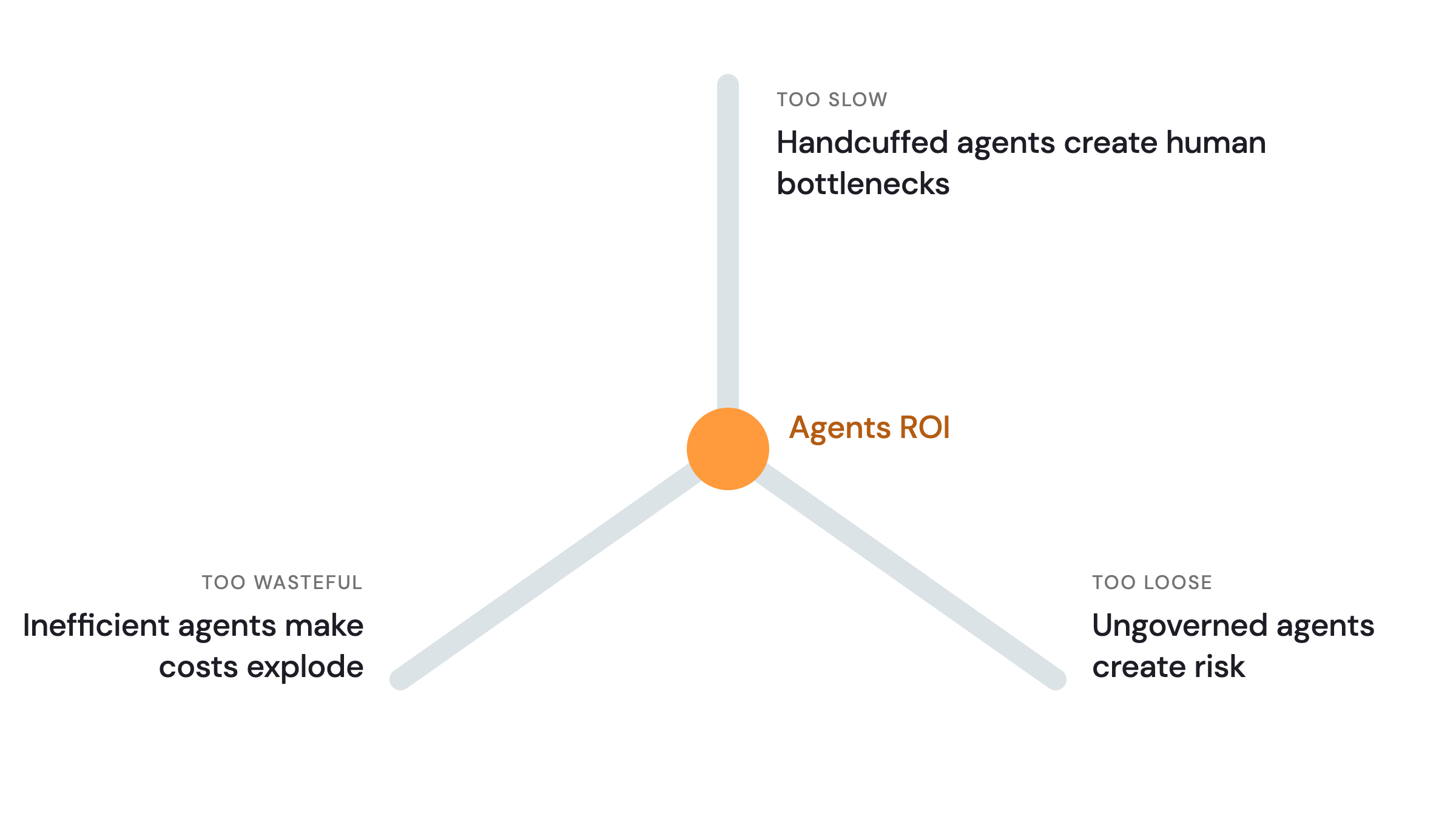
- Too loose - assets ship without review, and ungoverned agents create risk.
- Too slow - every change goes through a ticket queue, and handcuffed agents create human bottlenecks.
- Too wasteful - agents run, but nobody tunes them, and inefficient agents make costs explode.
When you need AgentOps
Most engineering organizations move through three levels of AI maturity. Each level brings a new kind of sprawl, and AgentOps becomes relevant as soon as the first one appears.
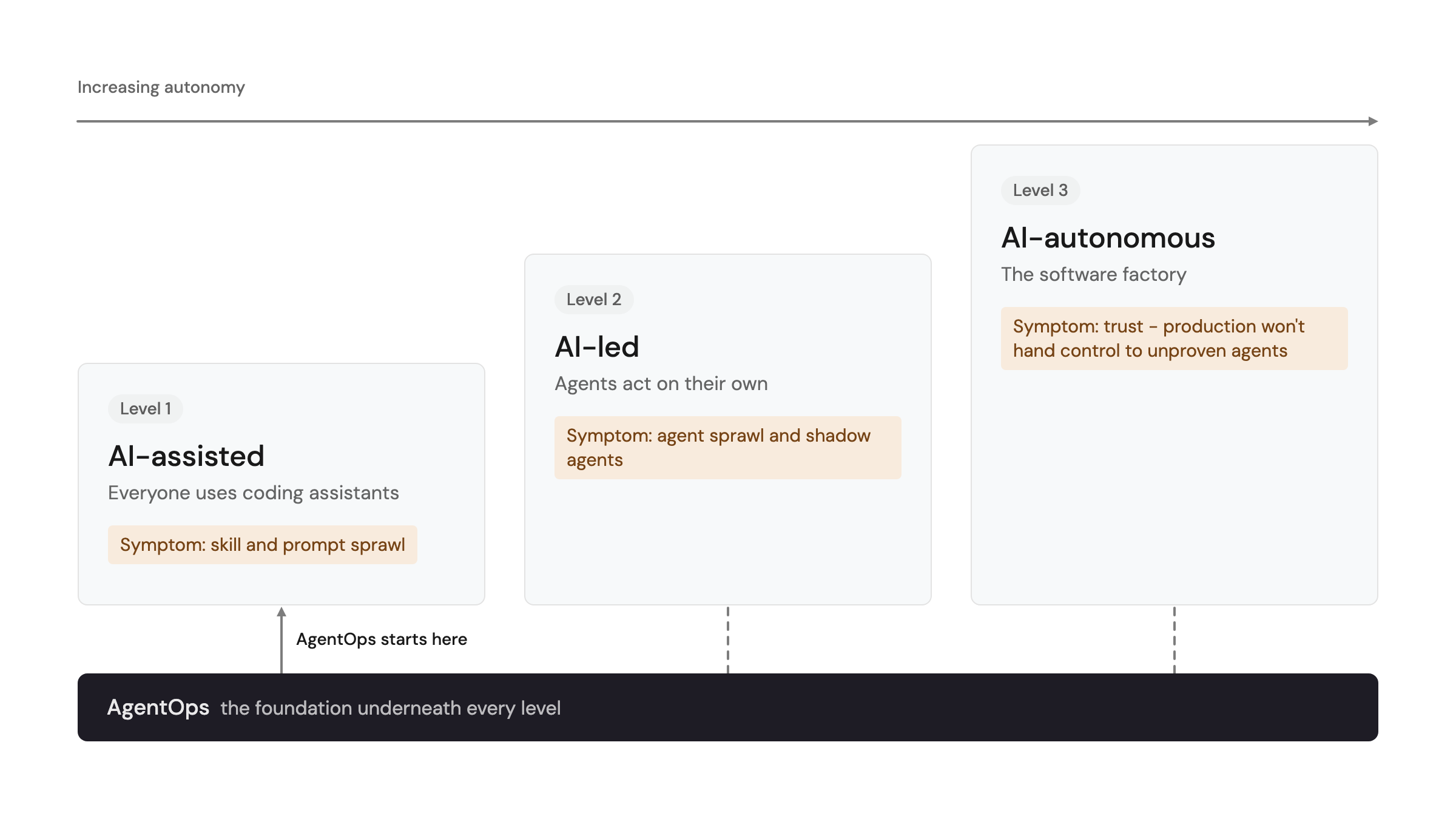
The risk grows as agent creation gets easier. Gartner predicts that over 40% of agentic AI projects will be canceled by the end of 2027, with inadequate risk controls among the main reasons.
A quick self-check. If you answer "no" to any of these questions, AgentOps will help:
- Could you list every agent running in your organization, and what each one can touch?
- Is there one shared place where developers find approved skills before writing new ones?
- Is there a standard, approved way to create a new agent or connect a new MCP server?
- Do you know what each agent run costs, and whether it is worth it?
How AgentOps feeds the software factory
At the AI-autonomous level, your SDLC becomes a software factory. Agents triage tickets, write code, review changes and respond to incidents, and humans approve the decisions that matter.
A factory only works if its machines are reliable. The agents doing the work have to be known, certified, scoped and measured. Because AgentOps runs on the same platform you use to build the software factory, Port can ensure that every machine on the line is one you govern and control: registered, owned, scoped to what it needs, audited and stoppable. That answers the questions security, compliance and finance teams ask before they let agents into the production SDLC, and it also makes the factory easier to build.
Think of your agents as the machines in that factory:
- You don't buy two machines for the same job. Duplicate agents that react to the same triggers waste money and produce conflicting results.
- A machine that takes 10 minutes for a 1-minute job gets fixed. Agents that loop or burn tokens get optimized.
- Every machine has an operator. Every agent has an owning team that is accountable for it.
- A machine is certified before it joins the line. Agents pass promotion gates before they reach production.
- A machine only touches the parts it is meant to. Agents get scoped access, not a developer's full permissions.
- Every line has an emergency stop. Every agent can be paused or shut down without a redeploy.
- Machines get scheduled maintenance. Self-improvement routines review agent sessions and improve them.
- You don't pay double for a machine when a person could do the job for half. ROI tracking shows when an agent costs more than the work it replaces, so you can fix it or retire it.
The four AgentOps practices
Port's AgentOps solution is organized around four practices, all built on the Context Lake. Each one builds on the one before it.
| Practice | What it does | Pages |
|---|---|---|
| Inventory | Know what exists. Bring every agent, skill, MCP server and plugin into one registry, connected to its owners, permissions and dependencies. | Agentic registry |
| Certification | Only approved, up-to-date assets reach production. Scorecards codify your standards as policy as code, golden paths make the compliant way the easiest way, and promotion gates control how agents move through their lifecycle stages. | Scorecards, golden paths, promotion gates |
| Enforcement | Every asset stays inside the boundaries it was certified for. Ownership, non-human identity, guardrails and audit apply to every agent, and a kill switch lets teams intervene and contain agents that misbehave. | Access and accountability, kill switch |
| Optimization | Assets keep getting better and cheaper after they go live. Self-improvement routines create continuous feedback loops from agent sessions back to the assets, and ROI tracking shows which assets are worth keeping. | Self-improvement routines, ROI measurement |
Why Port
- A connected Context Lake - Port registers your agentic assets as one dependency graph. Agents, skills, MCP servers, tools, teams, services and permissions are related entities, not separate lists in separate tools.
- Tool agnostic - agents come from any cloud or agent platform, skills and plugins come from any repository platform, and MCP servers connect through MCP connectors. You do not have to move anything to govern it.
- Orchestration with governance built in - workflows run on top of the Context Lake, with RBAC, approvals, scorecards and audit already part of the platform.
- One set of building blocks for humans and agents - the same blueprints, scorecards, self-service, permissions and dashboards your platform team uses for services and developers apply to agents and skills.
- Complements your stack - your agent platforms, AI gateways and evaluation tools stay where they are. Port connects them and adds the organizational layer they lack.
Next steps
- Get started with a skills registry - the fastest way to see value from AgentOps.
- Build your agentic registry - extend the registry to agents and MCP servers.