Measure the ROI of your agentic assets
Every agentic asset has a cost: tokens, platform fees and the time people spend reviewing and fixing its work. Some assets pay that back many times over. Others cost more than the work they replace, and some are never used at all.
ROI measurement tells you which is which, for every agent, skill and MCP server, so you can invest in the assets that work and retire the ones that don't.
Why measure the ROI of agentic assets
Today, AI spend is reported as one number per vendor, from invoices and usage consoles that don't know about your teams, your assets or the work they deliver.
With ROI measurement in Port, the cost of each asset in the agentic registry is connected to the outcomes it produces in the Context Lake, and ROI is calculated and scored per asset.
| Pain point | Without Port | With Port |
|---|---|---|
| No cost per asset | You know the total spend but not which agent or skill drives it, so budgets and accountability are guesswork. | Cost per agent and skill, so teams own their spend and budgets reflect real usage. |
| No basis for investment decisions | You keep paying for automation that costs more than the work it replaces, while the highest-value assets don't stand out. | An ROI scorecard ranks assets by cost against outcome, so you retire the ones that don't pay off and invest in the ones that pay back most. |
| No baseline | Leadership can't justify further AI investment with numbers. | ROI over time shows the return on every change, giving leadership numbers to invest with. |
Cost per asset
An asset's cost is more than its token bill:
- Model usage - tokens and spend per agent and per key, from your AI gateway and coding assistant analytics.
- Platform fees - runtime and hosting costs from agent platforms such as Claude managed agents, Amazon Bedrock and Azure AI Foundry.
- Human time - the approvals, reviews and rework the asset's output needs. Port records every approval step in its workflows, so you can see which agents need a human most often.
Human time is often the largest cost. An agent with a low token bill whose every change needs review is not cheap, and reducing the approvals it needs, for example as it moves through its promotion gates, is a measurable return.
Value per asset
Gateways and observability tools know what an agent cost. They don't know what it delivered. Port does, because the work agents produce is already in the Context Lake:
- Tickets resolved by an agent in autonomous ticket resolution.
- Pull requests merged that an agent authored or reviewed.
- Incidents mitigated with an agent's diagnosis or recommended response in self-healing incidents.
- Skill sessions that completed a task, from skills usage analytics.
Multiply each outcome by a baseline, such as the average time the same work takes a person, to get its value. Where no outcome data exists yet, the asset's owner can set an estimate and refine it over time.
Score ROI per asset
With cost and value on each asset, ROI is a calculation property in Port: the value an asset delivered in a period divided by what it cost in the same period.
A scorecard turns that number into levels your teams can act on, for example:
- Below 1x - the asset costs more than it saves.
- At least 1x - the asset pays for itself.
- At least 2x - the asset delivers clear value.
- At least 3x - the asset is a candidate to promote and reuse more widely.
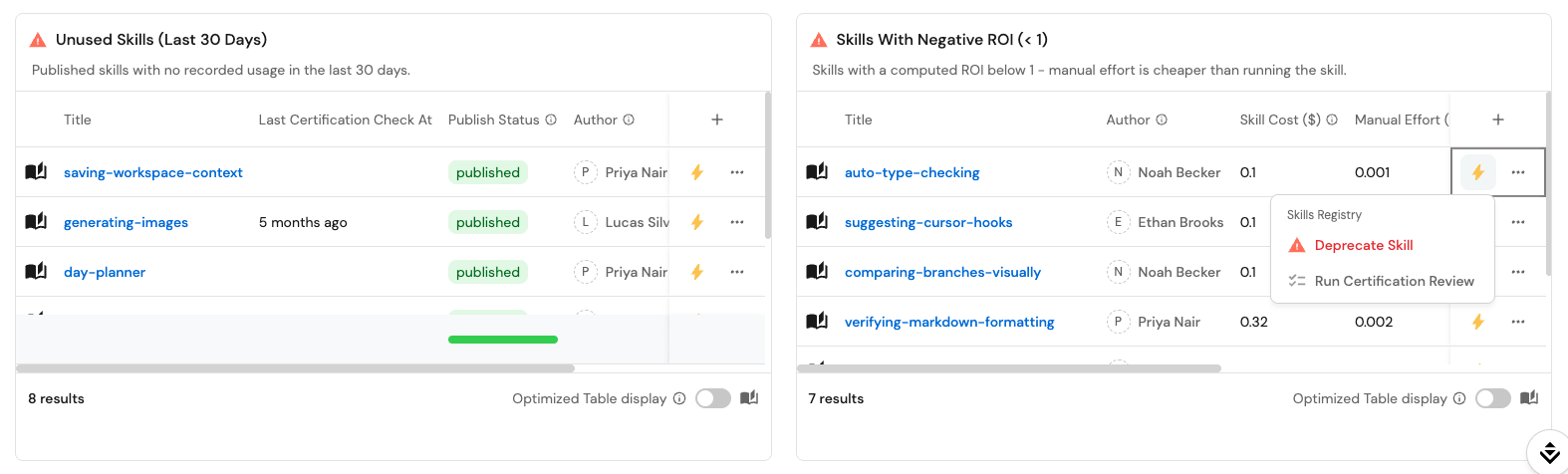
Low scores feed the rest of AgentOps. Unused or negative-ROI assets are retired through a golden path, and expensive ones are tuned by self-improvement routines.
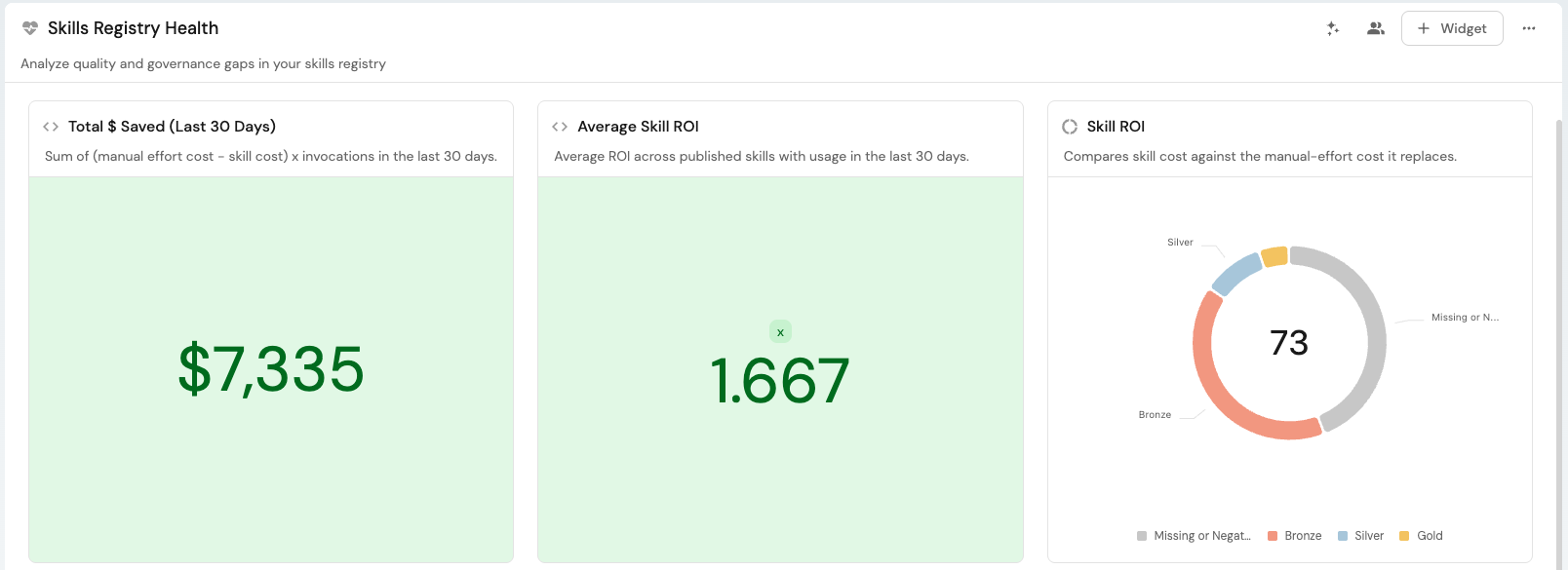
Example: skills ROI
The measure the ROI of skills in your org registry guide implements this model for skills. The same approach applies to agents and MCP servers.
How this relates to engineering intelligence
Engineering intelligence measures how AI affects delivery as a whole, such as AI impact on cycle time and throughput. ROI measurement looks one level down, at each individual asset, so you can decide which ones to keep, tune or retire.
Related guides and docs
- Measure the ROI of skills in your org registry - cost, effort and ROI properties for skills, with an ROI scorecard.
- Visualize Claude skills adoption - adoption, sharing and spend for Claude skills.
- Track AI coding assistants costs - cost data from coding assistants.
- Measure ATR's impact - outcome metrics for agents in autonomous ticket resolution.