Agentic resource management
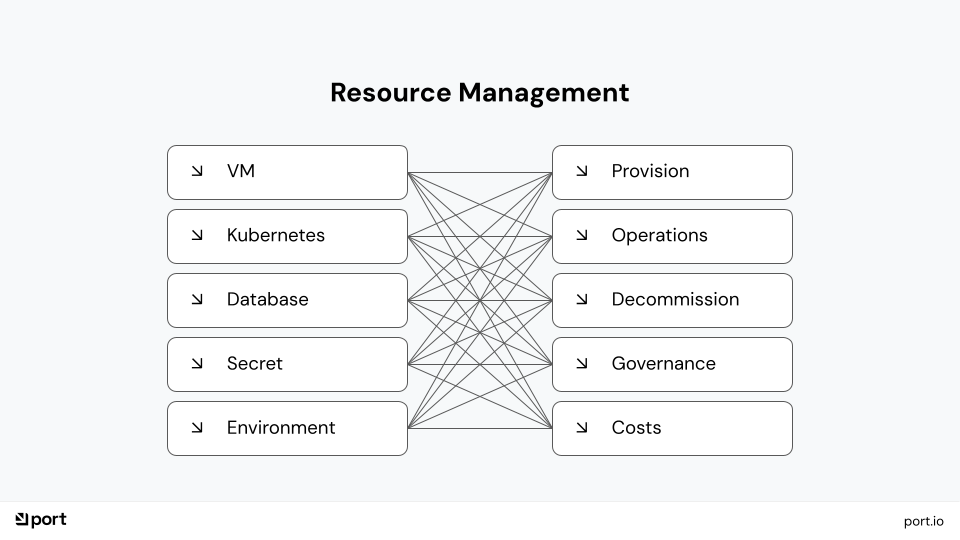
Agentic resource management is Port's approach to giving developers and AI agents full lifecycle control of infrastructure resources, while platform teams keep control of the standards.
Platform teams define golden paths, the organization's approved way of provisioning and operating resources. Developers and agents consume those golden paths to create, update, and decommission resources on demand. Because the golden path encodes your standards, engineering velocity does not come at the cost of governance.
The result is a resource layer that moves at developer speed for both humans and agents, without sacrificing platform control.
What problem it solves
Controlling infrastructure resources with tickets is a major bottleneck in the software development lifecycle. Every database, bucket, or namespace waits in a queue, and developers lose momentum while they wait.
When the queue gets too long, developers bypass the platform and provision resources themselves. Those resources often fail to meet the organization's standards for:
- Cost - untracked or oversized resources that inflate the cloud bill.
- Compliance - resources that skip required policies, tags, or approvals.
- Stability - misconfigured resources that cause incidents down the line.
This creates a tension between two failure modes: too slow (ticket queues and multi-day SLAs) and too loose (ungoverned provisioning that creates security gaps and cost overruns).
AI is an amplifier. Agents can request and provision resources far faster than humans, which makes the too-slow bottleneck more painful and the too-loose risk more dangerous. Agentic resource management resolves both sides of the tension at once by making the governed path the fast path.
How is this different from traditional self-service?
Agentic resource management is the evolution of self-service for the agentic era. The core idea is the same, enable developers through golden paths, but two things shift:
| Traditional self-service | Agentic resource management |
|---|---|
| Serves developers. | Serves developers and agents alike. |
| Centered on a UI developers navigate to. | Centered on the IDE, reached through the MCP server, wherever developers and agents already work. |
| Implemented as self-service actions with backend templates. | Implemented as agentic workflows with guardrails and context. |
Self-service in the agentic era
The "why" and "how" do not change: engineering velocity should not come at the cost of governance, and golden paths are how you deliver both. What changes is the "what". Instead of bringing developers to a separate UI, you serve golden paths directly into the coding environment where developers and agents work.
So, how does it work? A developer or agent expresses intent in their coding environment, for example "I need an S3 bucket for this service". Port's MCP server surfaces the relevant workflows based on that need and triggers them, without the developer ever leaving their IDE. The same golden path runs, the same guardrails apply, and the same audit trail is produced.
Why Port?
- AI agents as primitives. AI agents are first-class citizens in Port, subject to the same catalog, permissions, and guardrails as human users.
- Agentic workflows. Workflows orchestrate agents, humans, and tools into golden paths, with human-in-the-loop nodes wherever your policy requires review.
- Skills. Skills package your organization's "how-to" knowledge so agents handle specialized provisioning tasks consistently.
- Build Port with AI. Port is designed to be configured and extended with AI, so platform teams ship golden paths faster.
Customer stories
See how platform teams use Port to govern resource provisioning at scale:



Next steps
- Getting started - build an agentic workflow that provisions a new cloud resource using Infrastructure as Code.
- Golden paths - understand golden paths as the "how-to" of your organization, across the full resource lifecycle.
Port integrates with AWS, GCP, Azure, Kubernetes, Terraform, GitHub, GitLab, Jira, Slack, and 50+ other platforms, no migration required.