Governance at scale
As an organization scales, golden path workflows for day-0 and day-2 actions are no longer enough on their own. Thousands of resources across dozens of teams need oversight that doesn't depend on any one person watching every request. A few patterns help you keep control without becoming the bottleneck.
Approvals control panel
Some golden paths need a human in the loop. When they do, you don't want each approval scattered across Slack threads and individual runs.
In Port you can create a control panel for all the workflows that require your approval, in one place. From there you can:
- Track the progression of long-running processes.
- Analyze where requests stall to find bottlenecks.
- Use those insights to improve your golden paths over time.
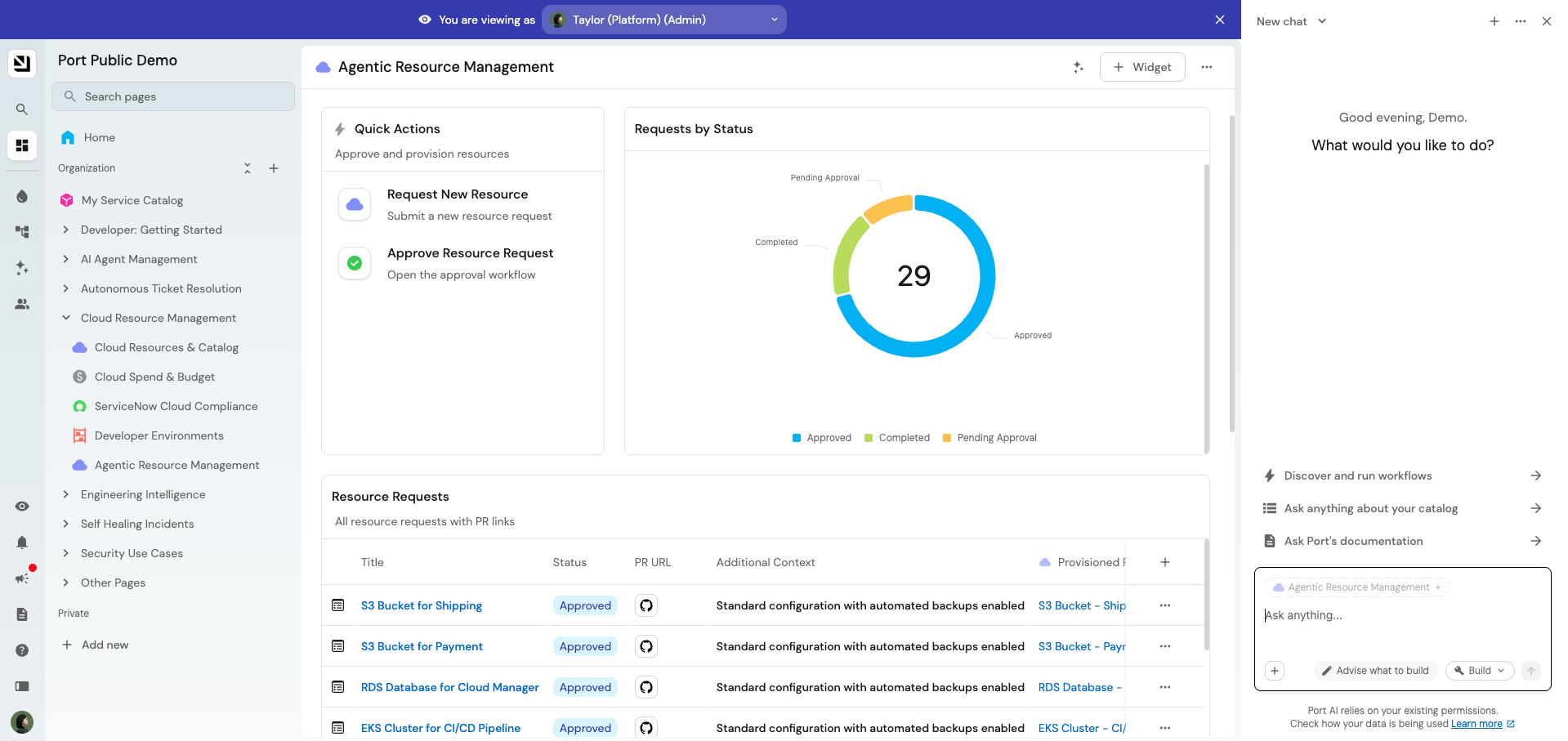
Design your agentic workflows to manage request entities with different statuses, so every pending decision is a tracked object rather than a message someone has to remember to act on. Use input nodes to add the human-in-the-loop steps, and track and manage runs to build the control panel that surfaces them.
Scorecards tracking
Scorecards are a deterministic way to track which resources align with your organizational standards. Instead of asking "is this resource compliant" by hand, you define the rule once and Port evaluates it automatically for every resource.
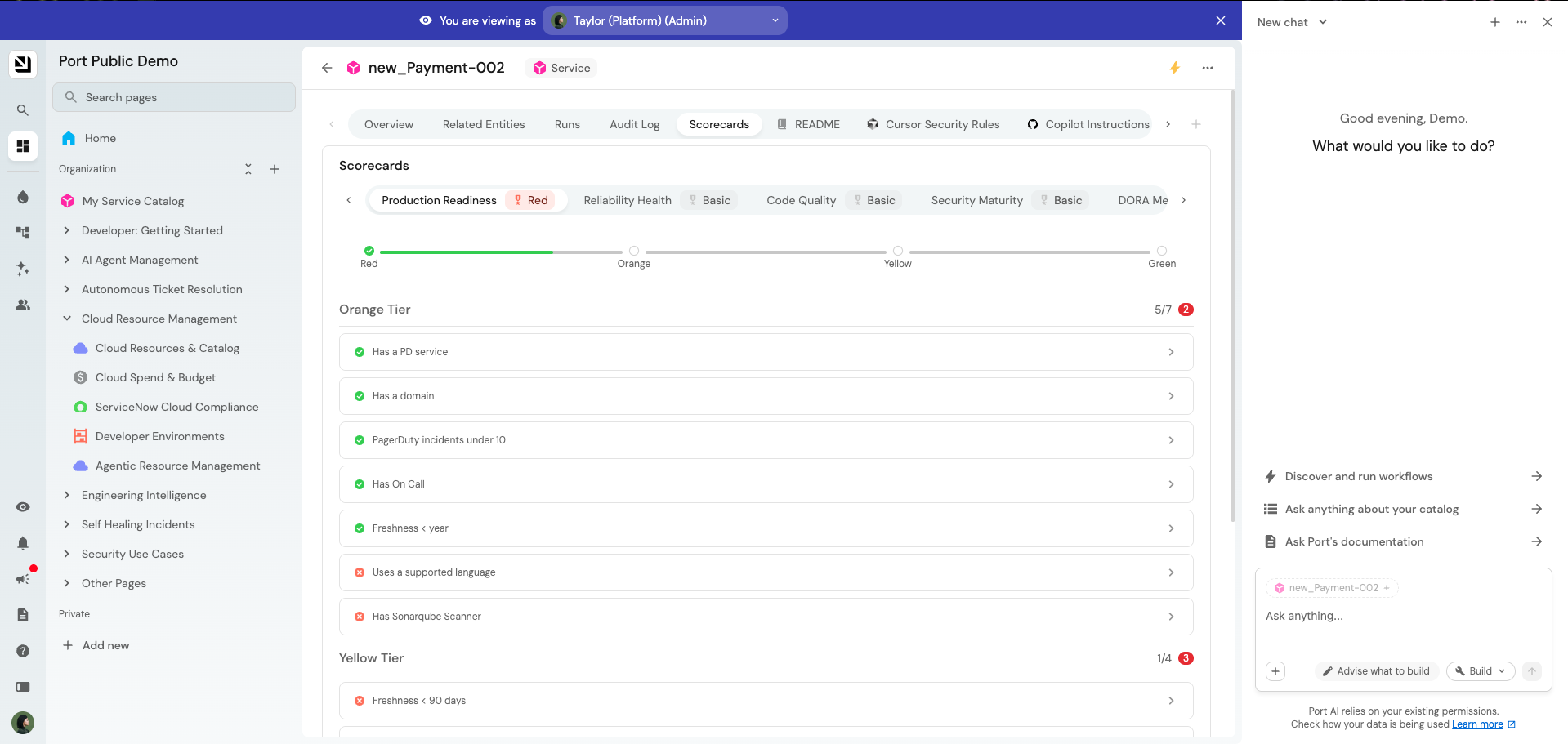
Both resources and scorecards are live objects. Resources change over their lifecycle, and scorecards change as your standards and policies evolve. Because both are live, you can close the loop: define an event-driven workflow that triggers when a scorecard breaks and runs an agentic golden path to bring the resource back into compliance.
This turns scorecards from a static report into a self-correcting system. When a standard changes, the resources that no longer meet it are flagged and, where you allow it, fixed automatically.
Platform teams hierarchy
Large-scale organizations usually have a core platform team alongside product or domain platform teams, each responsible for specific resource types, for example a data platform team owning databases, or a networking team owning VPCs and load balancers.
Port's custom data model lets you nest these standards. The core platform team builds a golden path that the product platform teams use to create their own golden paths, so the standards flow down one level rather than being reinvented by each team. For example, the core team defines a golden path for "publish a new resource type" that already bakes in required tags, cost controls, and approval gates; the data platform team uses it to publish their "provision a database" golden path, which developers and agents then consume, and every database golden path inherits the core standards automatically.
This keeps two layers of standards enforced at once:
- High-level standards, owned by the core platform team, apply everywhere.
- Specific standards, owned by each product platform team, apply to their resource types.
Team roles and blueprint moderators scope each team to the resources it owns, so the core team keeps oversight while product teams move independently within the guardrails they've been given.
Next steps
- Common use cases - browse a catalog of golden paths that deliver value across our customers.