Report a bug
This guide demonstrates how to implement a Port workflow that reports bugs in Jira, ensuring prompt issue resolution and improving overall platform reliability. The workflow uses a webhook node to call Jira's API directly from Port, so everything runs natively in Port with no external CI pipeline required.
Common use cases
- Give developers and agents a governed, one-click way to file Jira bugs from Port.
- Capture the reporting user automatically so issues stay accountable.
- Standardize bug intake so every report includes a project, title, and description.
Prerequisites
- Complete the onboarding process.
- Access to your Jira organization with permissions to create issues.
- A Jira API token with permissions to create new issues.
Set up data model
If you haven't installed the Jira integration, you'll need to create a blueprint for Jira issues. However we highly recommend you install the Jira integration to have these automatically set up for you.
Create the Jira issue blueprint
-
Go to the Data model page in Port.
-
Click on
+ Blueprint. -
Click on the
{...} Edit JSONbutton. -
Copy and paste the following JSON configuration:
Jira issue blueprint (click to expand)
{"identifier": "jiraIssue","title": "Jira Issue","icon": "Jira","schema": {"properties": {"url": {"title": "Issue URL","type": "string","format": "url","description": "URL to the issue in Jira"},"status": {"title": "Status","type": "string","description": "The status of the issue"},"issueType": {"title": "Type","type": "string","description": "The type of the issue"},"components": {"title": "Components","type": "array","description": "The components related to this issue"},"assignee": {"title": "Assignee","type": "string","format": "user","description": "The user assigned to the issue"},"reporter": {"title": "Reporter","type": "string","description": "The user that reported to the issue","format": "user"},"priority": {"title": "Priority","type": "string","description": "The priority of the issue"},"created": {"title": "Created At","type": "string","description": "The created datetime of the issue","format": "date-time"},"updated": {"title": "Updated At","type": "string","description": "The updated datetime of the issue","format": "date-time"}}},"calculationProperties": {},"relations": {}} -
Click "Save" to create the blueprint.
Set up the workflow
You can create Jira bugs by leveraging Port's workflows and secrets to interact with Jira's API directly through a webhook node. This method handles everything within Port, with no external pipeline to maintain.
Add Port secret
If you have already installed Port's Jira integration, these secrets should already exist in Port. To view your existing secrets:
- Open the Credentials modal.
- Click on the
Secretstab.
To add the secret to Port:
-
Open the Credentials modal.
-
Click on the
Secretstab. -
Click on
+ Secretand add the following secret:-
JIRA_AUTH- Base64 encoded string of your Jira credentials. Generate this by running:echo -n "your-email@domain.com:your-api-token" | base64Replace
your-email@domain.comwith your Jira email andyour-api-tokenwith your Jira API token.One time generationThe base64 encoded string only needs to be generated once and will work for all webhook calls until you change your API token.
-
Build the workflow
The workflow has three nodes:
- Trigger - a self-service trigger that collects the Jira project, a short title, and a description from the reporter.
- Create Jira issue - a webhook node that calls Jira's API to create the bug with the reporting user attached.
- Upsert Jira issue entity - an upsert entity node that creates a matching
Jira issueentity in your catalog from the Jira API response.
To create the workflow:
-
Go to the workflows page in Port.
-
Click + Workflow.
-
Fill out the Create new workflow form. For Name, enter
Report a bug, then click Confirm. -
Click the
{...}button to open the JSON editor and paste the workflow JSON below:Configure your Jira urlReplace
<JIRA_ORGANIZATION_URL>in the webhook URL with your Jira organization URL (e.g.,example.atlassian.net).Report a bug workflow (click to expand)
{"identifier": "report_a_bug","title": "Report a bug","icon": "Jira","description": "Report a bug in Port to our product team.","allowAnyoneToViewRuns": true,"nodes": [{"identifier": "trigger","title": "Bug details","config": {"type": "SELF_SERVE_TRIGGER","userInputs": {"properties": {"project": {"title": "Project","description": "The Jira project where the bug will be created","icon": "Jira","type": "string","format": "entity","blueprint": "jiraProject"},"short_title": {"icon": "DefaultProperty","title": "Short title","type": "string"},"description": {"icon": "DefaultProperty","title": "Description","type": "string"}},"required": ["project", "short_title", "description"],"order": ["project", "short_title", "description"]}}},{"identifier": "create_jira_issue","title": "Create Jira issue","config": {"type": "WEBHOOK","url": "https://<JIRA_ORGANIZATION_URL>/rest/api/3/issue","method": "POST","synchronized": true,"headers": {"Authorization": "Basic {{ .secrets.JIRA_AUTH }}","Content-Type": "application/json"},"body": {"fields": {"project": {"key": "{{ .outputs.trigger.project }}"},"summary": "{{ .outputs.trigger.short_title }}","description": {"version": 1,"type": "doc","content": [{"type": "paragraph","content": [{"type": "text","text": "{{ .outputs.trigger.description }}"}]},{"type": "paragraph","content": [{"type": "text","text": "Reported by: {{ .workflowRun.trigger.by.email }}"}]}]},"issuetype": {"name": "Bug"}}}}},{"identifier": "upsert_jira_issue","title": "Upsert Jira issue entity","config": {"type": "UPSERT_ENTITY","blueprintIdentifier": "jiraIssue","mapping": {"identifier": "{{ .outputs.create_jira_issue.response.data.key }}","title": "{{ .outputs.trigger.short_title }}","properties": {"url": "{{ .outputs.create_jira_issue.response.data.self | split(\"/rest/\") | .[0] }}/browse/{{ .outputs.create_jira_issue.response.data.key }}","status": "Open","issueType": "Bug","reporter": "{{ .workflowRun.trigger.by.email }}","created": "{{ now | todateiso8601 }}","updated": "{{ now | todateiso8601 }}"}}}}],"connections": [{"sourceIdentifier": "trigger","targetIdentifier": "create_jira_issue"},{"sourceIdentifier": "create_jira_issue","targetIdentifier": "upsert_jira_issue"}]} -
Click Apply changes.
Now you should see the Report a bug workflow in the self-service page. 🎉
Let's test it!
-
Go to the Self-service page in Port.
-
Click on the Report a bug workflow.
-
Fill in the bug details:
- Select the Jira project where the bug will be created.
- Enter a short title for the bug.
- Enter the bug description.
-
Click Execute.
-
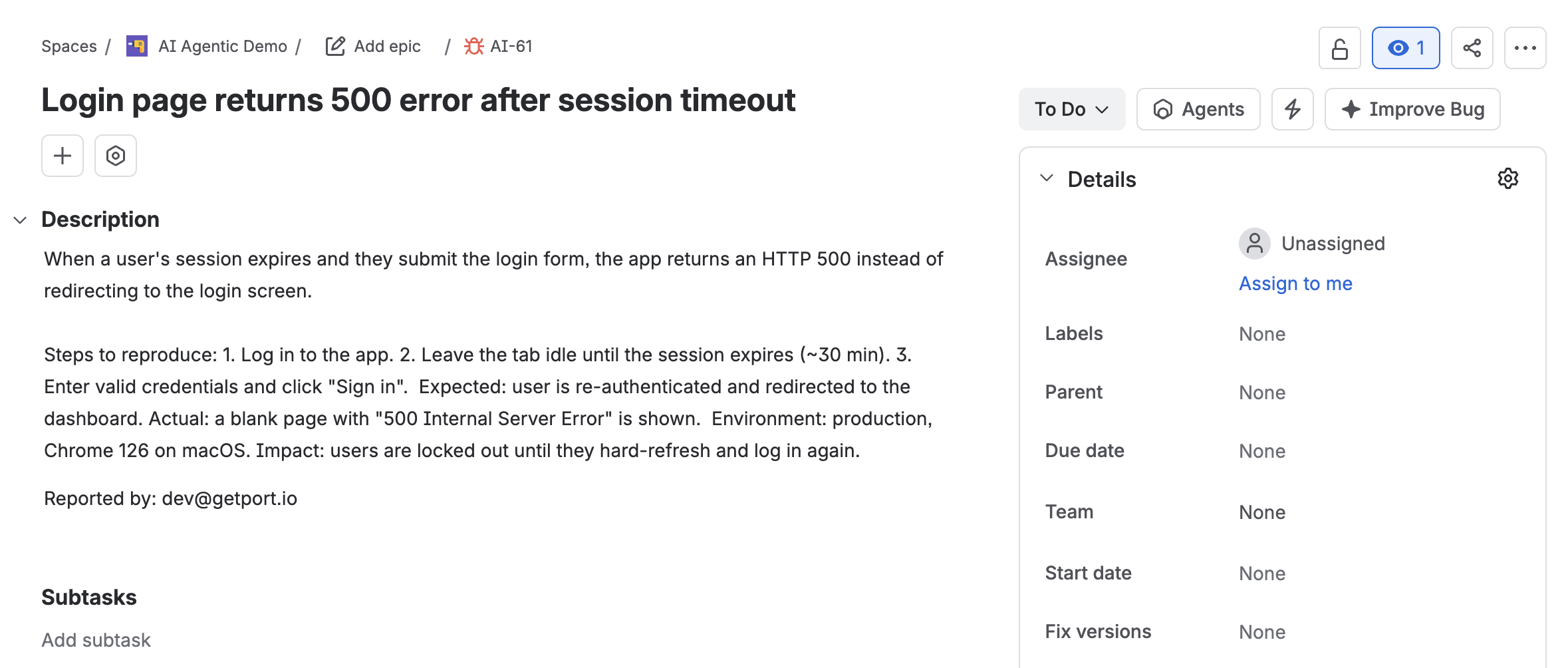
Open the workflow runs tab, then confirm the run completed, the new bug appears in the selected Jira project, and a matching
Jira issueentity was created in your catalog.