Factory lines
Factory lines are Port's governed, end-to-end processes for engineering work. Each factory line takes one kind of work, such as a ticket, an incident, or a security finding, and carries it through a series of stages, run by agents, workflows, and people, to an outcome like a merged pull request or a resolved incident.
Your factory lines make up your organization's AI software factory. All lines share the same context lake, registries, and governance, and each part of a line builds on the other Port pillars: the context lake, workflows, agents, interfaces, and governance.
Factory lines are currently in closed beta, and this documentation is a work in progress.
- To see what content will be added, see what to expect.
- To request access to factory lines for your organization, contact Port's support team.
Why factory lines
Homegrown AI factories often never leave the pilot stage. Agents work from scattered, unverified context and reach tools nobody approved. Teams can't see or steer what's running, who can use which agent or tool, at what cost, or when a human steps in. What works for one team doesn't scale, because each team builds its own agents and workflows, and the result is sprawl.
A factory line gives one kind of engineering work a single business process, from arrival to an outcome such as a merged pull request or a resolved incident:
- Run from wherever you work - Work enters from the tools you already use, or through Port's MCP server or the factory API.
- Governed stages - Each stage works from the context lake, and its checkpoints and human approvals keep people in control where you want them.
- Visibility and control of every run - You watch and steer each work item from the factory home, whether it is queued, running, awaiting input, failed, done, or cancelled.
- Measurement you can act on - Each try records its outcome, work and wait time, human interventions, and tokens and cost when the executor reports them. You see where work waits, what it costs, and where people step in.
How a factory line works
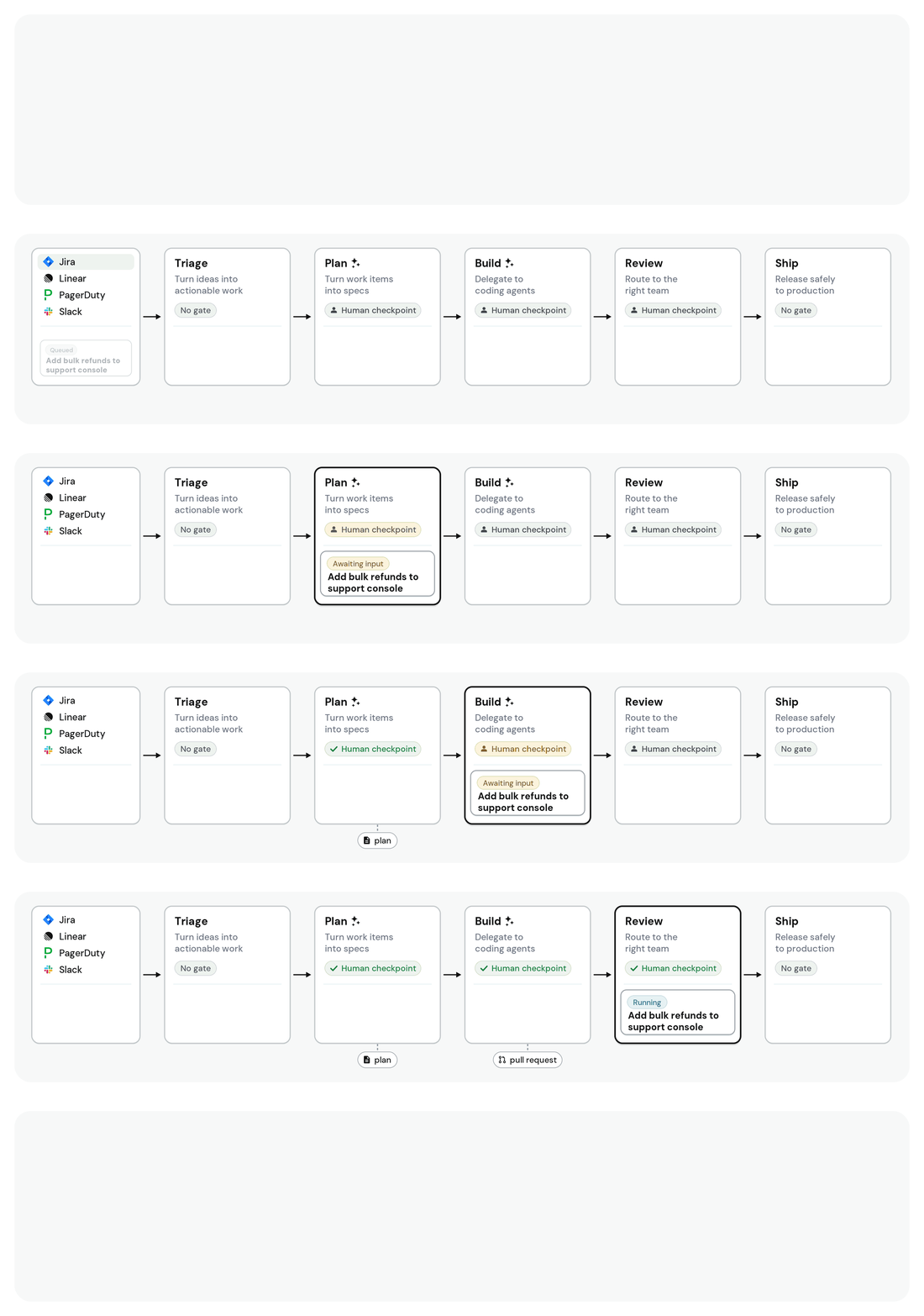
A factory line takes one kind of engineering work from arrival to outcome. A work item enters the line, moves through ordered stages, and leaves when the line finishes its job.
Work enters the line
Work arrives from the tools you already use: a ticket in Jira, an incident in PagerDuty, or a finding from your security scanner. Port treats that unit of work as a work item and enriches it with context from the context lake, such as the service it affects, who owns it, and related history.
An integration, Port's MCP server, or the factory API files the work item on the line.
Stages move the work forward
Each stage does one part of the job:
- Reads the work item and the context it needs.
- Hands the work to its executor, such as an AI agent from your registries, one of your workflows, or a person.
- Produces artifacts for later stages and reviewers, such as a plan or a pull request.
- Decides whether the work item can move on, using its checkpoints and optional human approval.
For example, the Idea to Production line uses five stages: triage, plan, build, review, and ship.
You can watch and steer each run
As a work item moves through the line, it is queued, running, awaiting input, failed, done, or cancelled. Each try of a stage leaves a stage run you can inspect. Teams review active work, provide input, and retry failed stages from the factory home.
How a factory line fits in the software factory
An AI software factory is the full system your organization runs: shared context, workflows, agents, interfaces, and governance working together across the SDLC. A factory line is how that factory is organized for one kind of engineering work.
Your factory can run many lines at once. All lines share the same context lake, registries, and governance. Each line has its own stages, agents, and outcomes.
The relationship looks like this:
- The software factory is the platform as a whole: the pillars, the shared catalog, and the rules that apply everywhere.
- A factory line is one end-to-end flow on that factory floor. Work enters the line, moves through its stages, and leaves as an outcome such as a merged pull request or a resolved incident.
- Work items are the units of work that move through a line, such as a ticket, an idea, or an incident.
- Stages are the steps of that flow. Each stage has an executor, such as an agent or a workflow, and checkpoints, including human approval where you want it.
So the factory is the whole. A line is one production path through it. The table below shows which Port pillar each part of a line uses.
How a factory line maps to Port
Every factory line is made of the same parts. A line holds its ordered stages, and each stage names who does its work. Work items move through those stages. Each stage produces artifacts and records a stage run.
Each part of a factory line is built from a Port pillar you can configure on its own:
| Part of the line | Port concept | Where to learn more |
|---|---|---|
| The data each stage reads | Context lake: blueprints, entities, integrations, and ownership | Context lake |
| Who does the work in each stage | Executors: Claude managed agents, your own workflows, or people | Workflows |
| The agents that do the work | AI agents, skills, and MCP servers in your registries | Agent management |
| Discovering agentic assets | Automatic discovery that keeps the registries current | Automatic discovery of agentic assets |
| Certifying agentic assets | Scorecards, golden paths, and promotion gates | Scorecards, golden paths, and promotion gates |
| The rules between stages | Checkpoints, and blueprint permissions for who can act on a line | Governance layer |
| The human-in-the-loop gates | Human input checkpoints that pause a stage for approvals and questions | Coming soon |
| The views of the line | Dashboards, the factory home, and Port AI | Interface builder and Port AI |
| Measuring and improving the factory | The signals each try records, and the changes you make because of them | Coming soon |
For example, the Idea to Production line runs in five stages: triage, plan, build, review, and ship. In each stage, an executor does the work, checkpoints decide whether the work can move on, and human approval keeps people in control where you need them. A work item on that line is a ticket or an idea, and at any point it is queued, running, awaiting input, failed, done, or cancelled.
Out-of-the-box factory lines
You don't have to design every line from scratch. Port provides ready-made factory lines for common engineering work, which you can start from and adapt to your own stages, agents, and checkpoints:
| Factory line | What it covers |
|---|---|
| Idea to Production | Carries a ticket or idea through a pull request to production, with human gates along the way. |
| Agentic infra management | Lets agents manage cloud and infrastructure resources under your policies. |
| Self-healing incidents | Detects, diagnoses, and remediates incidents. |
| Agentic leadership initiatives | Drives organization-wide initiatives with agents and scorecards. |
| Auto-fixed CI/CD | Lets agents repair failing pipelines and keep delivery green. |
| Auto-patching CVEs | Enriches security findings and opens governed fix pull requests. |
What to expect
This page is the first part of the factory lines documentation. The following pages will be added to this pillar:
- Concepts - The core building blocks of a factory line: stages, executors, checkpoints, work items, artifacts, stage runs, the factory home, registries, and the self-improving factory.
- Define a factory line - How to scope what a line does, from the work it takes in to the outcome it produces.
- Factory line execution - The ways a work item is filed on a line: from an integration, through Port's MCP server or the factory API, or by an agent that routes a request to the right line.
- Build a factory line - A step-by-step path for assembling a line in Port: its settings and permissions, the agent, skills, and MCP registries it draws from, its work items, and its stages with their executors, checkpoints, and human approvals. It also covers the artifacts and stage runs each stage records, the factory home where you track and act on work items, and the factory line page with its decision records and audit logs.
- Measurement and self-improvement - The signals a line records for each try and work item, and how you use them to improve its agents, context, and governance over time.
Until the factory lines feature is available, contact Port's support team to join the closed beta and get help setting up your first factory line.