Snyk

Port's Snyk integration allows you to model Snyk resources in your software catalog and ingest data into them.

Core support
Prerequisites
- A Snyk enterprise account.
- A Port organization with admin permissions.
The Snyk API is available for Enterprise customers only. Authentication using personal tokens from Snyk Free or Team plans is not supported. Learn More.
Setup
Choose your preferred installation method below. Not sure which to pick? See the installation methods overview.
The prerequisites required for installation are listed below.
-
Go to the Snyk Connectors page in Port.
-
Under
Select your installation method, chooseHosted by Port. -
Configure the
Installation parametersandAdvanced configurationas you wish (see below for details).
Installation parameters
Each integration requires specific parameters (such as an API token, a URL, etc.), as seen in Port's UI when installing it. Hover over the ⓘ icon next to each parameter to see more details about it.
Advanced configuration
- During the installation process each integration may have additional settings under the
Advanced configurationsection in Port's UI. Additionally, each integration has one or more settings that can be configured after installation. To do so, click on the integration's name in the Connectors page and navigate to theSettingtab. Hover over the ⓘ icon next to each setting to see more details about it.
Port secrets
Some integration settings require sensitive pieces of data, such as tokens. For these settings, Port secrets will be used, ensuring that your sensitive data is encrypted and secure.
When filling in such a setting, its value will be obscured (shown as ••••••••).
For each such setting, Port will automatically create a secret in your organization.
To see all secrets in your organization, follow these steps.
Limitations
- The maximum time for a full sync to run is based on the configured resync interval. For very large amounts of data where a resync operation is expected to take longer, please use a longer interval.
- Due to Snyk's v1 + REST API limitations, only project and target related events are supported.
- No deletion events are supported in Snyk.
Port source IP addresses
When using this installation method, Port will make outbound calls to your 3rd-party applications from static IP addresses. You may need to add these addresses to your allowlist, in order to allow Port to interact with the integrated service:
- Europe (EU):
54.73.167.226,63.33.143.237,54.76.185.219 - United States (US):
3.234.37.33,54.225.172.136,3.225.234.99
-
Go to the Snyk Connectors page in your portal.
-
Select the
Self-hostedmethod. -
A
helmcommand will be displayed, with default values already filled out (e.g. your Port client ID, client secret, etc). Copy the command, replace the placeholders with your values, then run it in your terminal to install the integration.
Required parameters:
port.clientId- Your Port client ID (How to get the credentials).port.clientSecret- Your Port client secret (How to get the credentials).port.baseUrl- Your Port API URL (https://api.port.iofor EU,https://api.us.port.iofor US).integration.identifier- A unique identifier for your integration.integration.type- The integration type.integration.eventListener.type- The event listener type.integration.secrets.token- The Snyk API token.integration.config.appHost- The host of the Port Ocean app. Used to set up the integration endpoint as the target for Webhooks created in Snyk.
Optional parameters (click to expand)
integration.config.apiUrl- The Snyk API URL. If not specified, the default will behttps://api.snyk.io.integration.secret.webhookSecret- This is a password you create, that Snyk uses to sign webhook events to Port.scheduledResyncInterval- The number of minutes between each resync.initializePortResources- Defaulttrue. When set totrue, the integration will create default blueprints and the port App config Mapping.sendRawDataExamples- Whentrue, sends raw data examples from the third-party API to Port for testing and managing the integration mapping.
By default, the integration fetches all organizations associated with the provided Snyk token. If you wish to customize access, the following parameters are available:
integration.config.organizationId- The Snyk organization ID. Fetches data for this organization when provided.integration.config.groups- A comma-separated list of Snyk group ids to filter data for. Fetches data for organizations within the specified groups.
If you're running high volumes of live events in a self-hosted deployment and want better reliability, event durability, or horizontal scalability, you can optionally set up Port's dedicated live events infrastructure. See live events at scale for details.
Recommended resource sizes
To ensure optimal performance and avoid out-of-memory (OOM) errors, we recommend the following resources for this integration:
- CPU Limit:
800m - CPU Request:
100m - Memory Limit:
1Gi - Memory Request:
1Gi
Set resource values
helm install my-integration port-labs/port-ocean \
# ... other parameters
--set resources.limits.cpu=800m \
--set resources.limits.memory=1Gi \
--set resources.requests.cpu=100m \
--set resources.requests.memory=1Gi
- GitHub
- Jenkins
- Azure DevOps
- GitLab
- Go to the Snyk Connectors page in your portal.
- Under Select your installation method, choose your desired CI/CD platform.
- Copy the workflow and replace the placeholders with your values.
Below are the available parameters and their descriptions.
| Parameter | Description | Required? | Secret?Store this value as a GitHub Actions secret |
|---|---|---|---|
port_client_id | Your Port client ID (How to get the credentials). | ✓ | ✓ |
port_client_secret | Your Port client secret (How to get the credentials). | ✓ | ✓ |
port_base_url | Your Port API URL (https://api.port.io for EU, https://api.us.port.io for US). | ✓ | ✗ |
token | The Snyk API token. | ✓ | ✓ |
organization_id | The Snyk organization ID. By default, the integration fetches all organizations associated with the provided token. Use this parameter to restrict access to a specific organization. | ✗ | ✗ |
groups | A comma-separated list of Snyk group IDs. Use this parameter to restrict access to organizations within specific groups. By default, all organizations are fetched. | ✗ | ✗ |
api_url | The Snyk API URL. If not specified, the default will be https://api.snyk.io. | ✗ | ✗ |
initialize_port_resources | Default true. When set to true, the integration will create default blueprints and the Port app config mapping. | ✗ | ✗ |
integration_identifier | The identifier of the integration that will be installed. | ✗ | ✗ |
send_raw_data_examples | Enable sending raw data examples from the third-party API to Port for testing and managing the integration mapping. Default is true. | ✗ | ✗ |
Your Jenkins agent must be able to run Docker commands.
Below are the available parameters and their descriptions.
| Parameter | Description | Required? | Secret?Store this value as a Jenkins credential (Secret Text) |
|---|---|---|---|
OCEAN__ | Your Port client ID (How to get the credentials). | ✓ | ✓ |
OCEAN__ | Your Port client secret (How to get the credentials). | ✓ | ✓ |
OCEAN__ | Your Port API URL (https://api.port.io for EU, https://api.us.port.io for US). | ✓ | ✗ |
OCEAN__ | The Snyk API token. | ✓ | ✓ |
OCEAN__ | The Snyk organization ID. By default, the integration fetches all organizations associated with the provided token. Use this parameter to restrict access to a specific organization. | ✗ | ✗ |
OCEAN__ | A comma-separated list of Snyk group IDs. Use this parameter to restrict access to organizations within specific groups. By default, all organizations are fetched. | ✗ | ✗ |
OCEAN__ | The Snyk API URL. If not specified, the default will be https://api.snyk.io. | ✗ | ✗ |
OCEAN__ | Default true. When set to true, the integration will create default blueprints and the Port app config mapping. | ✗ | ✗ |
OCEAN__ | The identifier of the integration that will be installed. | ✗ | ✗ |
OCEAN__ | Enable sending raw data examples from the third-party API to Port for testing and managing the integration mapping. Default is true. | ✗ | ✗ |
Here is an example for a Jenkinsfile pipeline file:Jenkins pipeline (click to expand)
Prerequisites
- Your Azure Devops agent should be able to run docker commands. Learn more about agents here.
- You must have permissions to create and manage Azure DevOps variable groups for storing credentials.
Set up your credentials
- Create a Variable Group: Name it port-ocean-credentials.
- Store the required variables (see the table below).
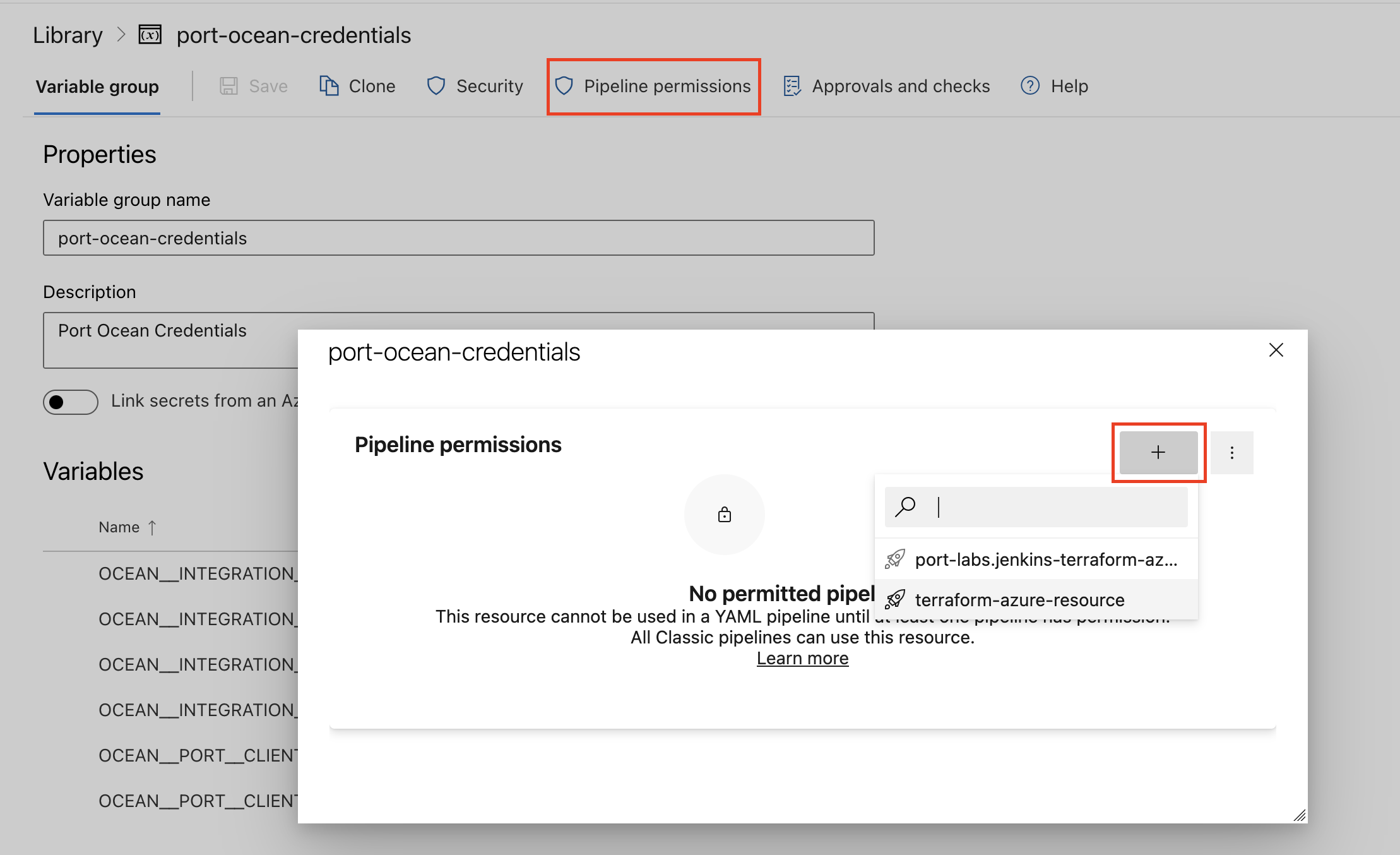
- Authorize Your Pipeline:
-
Go to "Library" -> "Variable groups."
-
Find port-ocean-credentials and click on it.
-
Select "Pipeline Permissions" and add your pipeline to the authorized list.
-
Below are the available parameters and their descriptions.
| Parameter | Description | Required? | Secret?Store this value as an Azure DevOps pipeline variable |
|---|---|---|---|
OCEAN__ | Your Port client ID (How to get the credentials). | ✓ | ✓ |
OCEAN__ | Your Port client secret (How to get the credentials). | ✓ | ✓ |
OCEAN__ | Your Port API URL (https://api.port.io for EU, https://api.us.port.io for US). | ✓ | ✗ |
OCEAN__ | The Snyk API token. | ✓ | ✓ |
OCEAN__ | The Snyk organization ID. By default, the integration fetches all organizations associated with the provided token. Use this parameter to restrict access to a specific organization. | ✗ | ✗ |
OCEAN__ | A comma-separated list of Snyk group IDs. Use this parameter to restrict access to organizations within specific groups. By default, all organizations are fetched. | ✗ | ✗ |
OCEAN__ | The Snyk API URL. If not specified, the default will be https://api.snyk.io. | ✗ | ✗ |
OCEAN__ | Default true. When set to true, the integration will create default blueprints and the Port app config mapping. | ✗ | ✗ |
OCEAN__ | The identifier of the integration that will be installed. | ✗ | ✗ |
OCEAN__ | Enable sending raw data examples from the third-party API to Port for testing and managing the integration mapping. Default is true. | ✗ | ✗ |
Here is an example for a Your Azure Devops agent should be able to run docker commands.azure-pipeline.yml pipeline file:Azure pipeline (click to expand)
- Go to the Snyk Connectors page in your portal.
- Under Select your installation method, choose your desired CI/CD platform.
- Copy the workflow and replace the placeholders with your values.
Below are the available parameters and their descriptions.
| Parameter | Description | Required? | Secret?Store this value as a GitLab CI/CD variable |
|---|---|---|---|
OCEAN__ | Your Port client ID (How to get the credentials). | ✓ | ✓ |
OCEAN__ | Your Port client secret (How to get the credentials). | ✓ | ✓ |
OCEAN__ | Your Port API URL (https://api.port.io for EU, https://api.us.port.io for US). | ✓ | ✗ |
OCEAN__ | The Snyk API token. | ✓ | ✓ |
OCEAN__ | The Snyk organization ID. By default, the integration fetches all organizations associated with the provided token. Use this parameter to restrict access to a specific organization. | ✗ | ✗ |
OCEAN__ | A comma-separated list of Snyk group IDs. Use this parameter to restrict access to organizations within specific groups. By default, all organizations are fetched. | ✗ | ✗ |
OCEAN__ | The Snyk API URL. If not specified, the default will be https://api.snyk.io. | ✗ | ✗ |
OCEAN__ | Default true. When set to true, the integration will create default blueprints and the Port app config mapping. | ✗ | ✗ |
OCEAN__ | The identifier of the integration that will be installed. | ✗ | ✗ |
OCEAN__ | Enable sending raw data examples from the third-party API to Port for testing and managing the integration mapping. Default is true. | ✗ | ✗ |
Configuration
Port integrations use a YAML mapping block to ingest data from the third-party api into Port.
The mapping makes use of the JQ JSON processor to select, modify, concatenate, transform and perform other operations on existing fields and values from the integration API.
Default mapping configuration
This is the default mapping configuration for this integration:
Default mapping configuration (click to expand)
deleteDependentEntities: true
createMissingRelatedEntities: true
enableMergeEntity: true
resources:
  - kind: organization
    selector:
      query: 'true'
    port:
      entity:
        mappings:
          identifier: .id
          title: .attributes.name
          blueprint: '"snykOrganization"'
          properties:
            slug: .attributes.slug
            url: ("https://app.snyk.io/org/" + .attributes.slug | tostring)
  - kind: project
    selector:
      query: 'true'
      attachIssuesToProject: 'false'
    port:
      entity:
        mappings:
          identifier: .id
          title: .attributes.name
          blueprint: '"snykProject"'
          properties:
            url: ("https://app.snyk.io/org/" + .__organization.slug + "/project/" + .id | tostring)
            businessCriticality: .attributes.business_criticality
            environment: .attributes.environment
            lifeCycle: .attributes.lifecycle
            highOpenVulnerabilities: .meta.latest_issue_counts.high
            mediumOpenVulnerabilities: .meta.latest_issue_counts.medium
            lowOpenVulnerabilities: .meta.latest_issue_counts.low
            criticalOpenVulnerabilities: .meta.latest_issue_counts.critical
            tags: .attributes.tags
            targetOrigin: .attributes.origin
          relations:
            snyk_target: '.relationships.target.data.id'
  - kind: target
    selector:
      query: 'true'
      attachProjectData: true
      apiQueryParams:
        exclude_empty: false   # set to false to include targets with no associated projects
    port:
      entity:
        mappings:
          identifier: .id
          title: .attributes.display_name
          blueprint: '"snykTarget"'
          properties:
            origin: .relationships.integration.data.attributes.integration_type
          relations:
            snyk_organization: '.relationships.organization.data.id'
  - kind: vulnerability
    selector:
      query: 'true'
    port:
      entity:
        mappings:
          identifier: .id
          title: .attributes.title
          blueprint: '"snykVulnerability"'
          properties:
            score: .attributes.risk.score.value
            packageNames: '[.attributes.coordinates[].representations[].dependency?.package_name | select(. != null)]'
            packageVersions: '[.attributes.coordinates[].representations[].dependency?.package_version | select(. != null)]'
            severity: .attributes.effective_severity_level
            url: ("https://app.snyk.io/org/" + .__organization.slug + "/project/" + .relationships.scan_item.data.id + "#issue-" + .attributes.key | tostring)
            publicationTime: .attributes.created_at
            status: .attributes.status
            type: .attributes.type
          relations:
            project: .relationships.scan_item.data.id
Monitoring and sync status
To learn more about how to monitor and check the sync status of your integration, see the relevant documentation.
Mapping & selectors per resource
Use the explorer below to view sample payloads and the resulting Port entities for each resource type.
- kind: organization
  selector:
    query: 'true'
  port:
    entity:
      mappings:
        identifier: .id
        title: .attributes.name
        blueprint: '"snykOrganization"'
        properties:
          slug: .attributes.slug
          url: ("https://app.snyk.io/org/" + .attributes.slug | tostring)
{
  "id": "a37b1727-ed7c-4f2c-9b59-7c5908e",
  "type": "org",
  "attributes": {
    "group_id": "c7ec7fa4-50ae-450f-8b48-49270cfc54b5",
    "is_personal": false,
    "name": "NFR - Shared",
    "slug": "nfr-shared",
    "created_at": "2023-08-14T18:34:58Z",
    "updated_at": "2025-08-22T10:09:27Z"
  },
  "relationships": {
    "member_role": {
      "data": {
        "id": "d8ba290b-aa9e-4957-9f0b-9409d7b4",
        "type": "org_role"
      }
    }
  },
  "group_id": "c7ec7fa4-50ae-450f-8b48-49270cfc",
  "is_personal": false,
  "name": "NFR - Shared",
  "slug": "nfr-shared",
  "created_at": "2023-08-14T18:34:58Z",
  "updated_at": "2025-08-22T10:09:27Z"
}
Set up live events
This integration supports live events, allowing real-time updates to your software catalog without waiting for the next scheduled sync.
Note that different events are supported depending on the resource type.
Project related eventsTarget related events- Hosted by Port
- Self-hosted
Live events base URL
For integrations installed using the Hosted by Port method, you can obtain the live events base URL from the Get an integration API. The response includes liveEventsUuid and liveEventsIngestHostname in the appSpec section.
Call the endpoint with your integration's identifier:
curl -X GET \
  'https://api.port.io/v1/integration/<INTEGRATION_IDENTIFIER>' \
  -H 'Authorization: Bearer <PORT_ACCESS_TOKEN>'
The port_region, port.baseUrl, portBaseUrl, port_base_url and OCEAN__PORT__BASE_URL parameters select which Port API instance to use:
- EU (app.port.io) →
https://api.port.io - US (app.us.port.io) →
https://api.us.port.io
In the response, look for the following fields under spec.appSpec:
{
  "spec": {
    "appSpec": {
      "liveEventsUuid": "abcdefghijk",
      "liveEventsIngestHostname": "ingest.ocean.getport.io"
    }
  }
}
Combine them to build the live events base URL:
https://<liveEventsIngestHostname>/live-events/<liveEventsUuid>
For example, with the values above, the live events base URL is:
https://ingest.ocean.getport.io/live-events/abcdefghijk
This is the same URL configured for the integration.
BaseUrl & webhook configuration
To enable real-time updates of the data in your software catalog, you need to define the liveEvents.baseUrl parameter.
This parameter should be set to the URL of your Snyk integration instance, which needs to have the option to setup webhooks via HTTP requests/receive HTTP requests, so ensure the network is configured accordingly.
- If Snyk and the integration are in the same cluster/network: Use an internal URL (e.g., a Kubernetes service DNS name).
For Kubernetes deployments, create a service to expose the integration pod and use the service URL asliveEvents.baseUrl. If both the source system and integration are in the same cluster, an internal ClusterIP service is sufficient. - If Snyk is external to the integration's network: The integration must be exposed via an ingress, load balancer, or public URL that Snyk can reach.
If you're running high volumes of live events in a self-hosted deployment and want better reliability, event durability, or horizontal scalability, you can optionally set up Port's dedicated live events infrastructure. See live events at scale for details.
If liveEvents.baseUrl is not provided, the integration will continue to function correctly. In such a configuration, to retrieve the latest information from the target system, the scheduledResyncInterval parameter has to be set, or a manual resync will need to be triggered through Port's UI.
To test webhooks or live event delivery to your local environment, expose your local pod or service to the internet using ngrok (e.g. ngrok http http://localhost:8000)