Port custom agents
What are Port AI Agents?
Port AI Agents are pre-configured, domain-specific entities built on Port AI that enable intelligent machine-to-machine communication. Unlike general AI assistants designed for human interaction, AI Agents are purpose-built for specific domains (like incident management, deployment orchestration, or security monitoring) and excel at autonomous operations within defined boundaries.
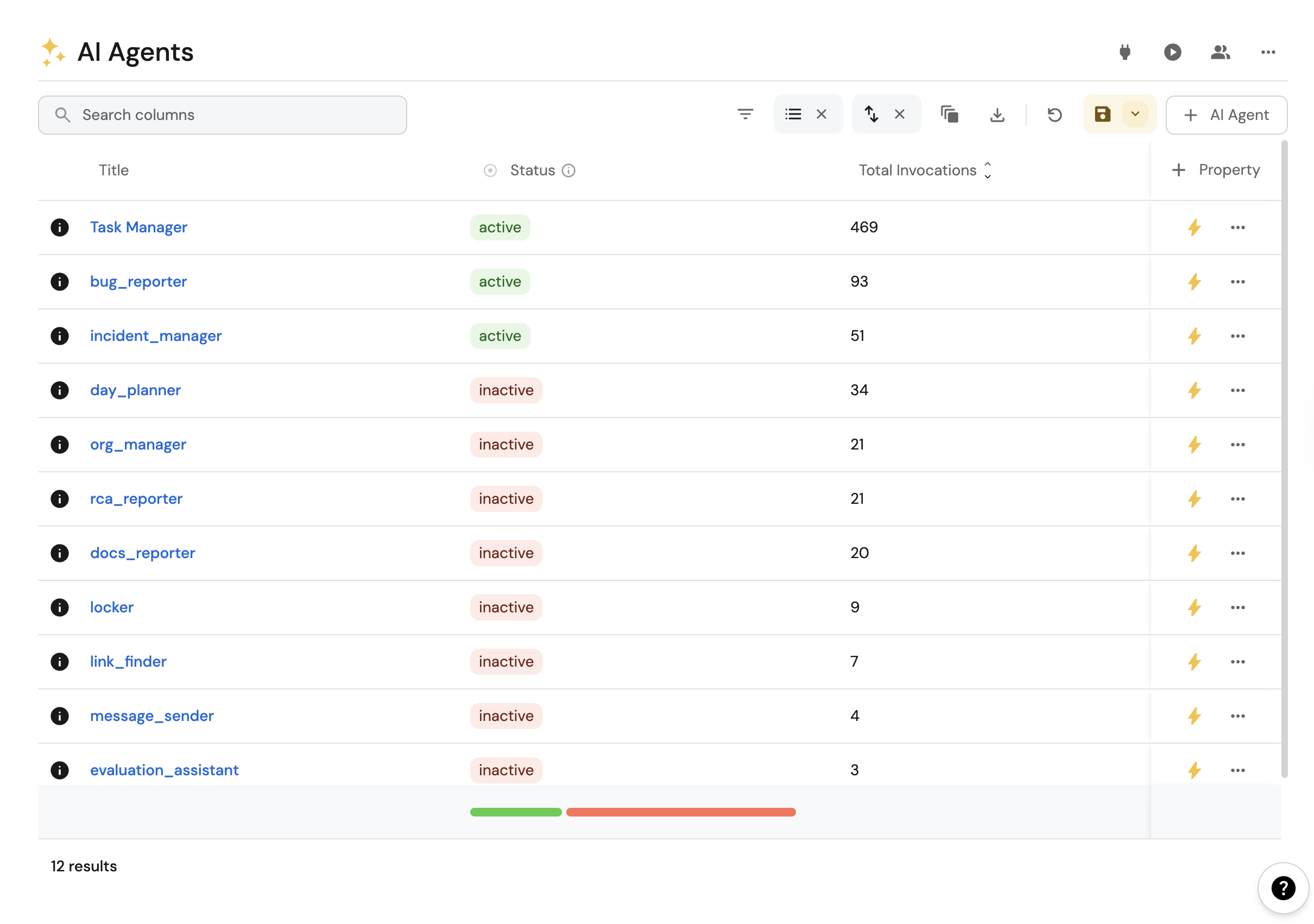
Agent Characteristics
AI Agents are distinguished by three key characteristics that make them ideal for machine-to-machine workflows:
- Domain Ownership - Each agent is specifically designed for a particular domain or function (incident management, security monitoring, deployment orchestration).
- Autonomous Operation - Agents operate independently within defined boundaries , making them perfect for automated workflows, background monitoring and alerting, and system-to-system communication where human intervention isn't required.
- Reusability Across Systems - Agents can be integrated into multiple systems and workflows, like API-driven integration, third-party system integrations, etc.
When to Use AI Agents vs Port AI
Choose AI Agents when you need:
- Machine-to-machine communication for automated workflows.
- Domain-specific expertise (e.g., incident response, security analysis).
- Autonomous operations that run without human intervention.
- Reusable logic that can be embedded in multiple systems.
Choose Port AI when you need:
- Human interaction and conversational interfaces.
- General-purpose queries across your entire catalog.
- Ad-hoc exploration and discovery.
Agent-Specific Use Cases
AI Agents excel at machine-to-machine scenarios that require domain expertise and autonomous operation:
- Kubernetes Healing Agent
- Incident Response Agent
- Security Compliance Agent
This agent automatically monitors and heals Kubernetes infrastructure by detecting failures, analyzing resource constraints, and triggering remediation workflows through monitoring system integrations.
Tools this agent would have:
- Kubernetes cluster monitoring and diagnostics.
- Resource utilization analysis tools.
- Pod restart and scaling automation.
- Alert correlation and notification systems.
Example scenarios:
- Automatically detects pod failures and restart issues.
- Analyzes resource constraints and suggests scaling actions.
- Integrates with monitoring systems to trigger remediation workflows.
This agent streamlines incident management by monitoring service health, creating automated incident reports, and reducing alert noise through intelligent correlation while keeping stakeholders informed throughout outages.
Tools this agent would have:
- Service health monitoring and alerting.
- Incident creation and management tools.
- Multi-system alert correlation engines.
- Stakeholder notification and communication systems.
Example scenarios:
- Monitors service health and automatically creates incident reports.
- Correlates alerts across multiple systems to reduce noise.
- Provides automated status updates to stakeholders during outages.
This agent continuously maintains security posture by scanning for vulnerabilities and misconfigurations, creating prioritized remediation tickets, and preventing vulnerable code from reaching production through CI/CD integration.
Tools this agent would have:
- Vulnerability scanning and assessment tools.
- Security misconfiguration detection systems.
- Automated ticket creation and prioritization.
- CI/CD pipeline integration and gates.
Example scenarios:
- Continuously scans for security vulnerabilities and misconfigurations.
- Automatically creates remediation tickets with context and priority.
- Integrates with CI/CD pipelines to prevent deployment of vulnerable code.
Getting Started with AI Agents
AI Agents are designed for organizations that need autonomous, domain-specific AI capabilities. Before applying, ensure you have:
- Experience with Port AI and its capabilities.
- Understanding of your specific automation and machine-to-machine communication needs.
- Familiarity with AI Security and Data Controls.
Configure agents in Port for your domains, then connect them to workflows and external systems. See Build agents and Interact with agents.
Access to the feature
Access to Port AI features (including AI Agents) is controlled through the _ai_invocation blueprint's permissions. Users need the Read, Register, and Update permissions on AI invocation entities to access and interact with AI features, including your AI Agents.
After building an agent, make sure to configure the appropriate permissions so your users can actually interact with it.
Creating an AI agent is not enough on its own - users also need the Read, Register, and Update permissions on the _ai_invocation blueprint to be able to invoke and interact with it.
Build and customize your AI agents for specific domains:
- Define agent instructions, goals, and expertise areas.
- Set allowed tools and configure autonomy levels for actions.
- Grant access to external MCP connector tools when the agent needs data or actions outside your Port catalog.
- Test agent behavior and validate responses.
- Integrate agents into workflow automations and external systems.
Security and Governance
AI Agents inherit all security and governance controls from Port AI. They operate within the same secure framework with additional controls for autonomous operation:
- RBAC compliance: Agents respect all data access permissions and policies.
- Audit trail: All agent interactions are logged as AI invocations for monitoring.
- Data governance: Same data handling policies as Port AI Security and Data Controls.
For comprehensive security information, see AI Security and Data Controls.
Implementation Strategy
Start with focused, high-value use cases that demonstrate clear ROI:
- Begin with monitoring and alerting - Implement agents that enhance existing observability.
- Add workflow automation - Build agents that streamline repetitive processes.
- Expand to complex orchestration - Develop agents that manage multi-system workflows.
- Scale across domains - Deploy specialized agents for different organizational areas.
Data Model
AI Agents use the same data model as Port AI with additional agent-specific blueprints:
-
AI agents (
_ai_agent) - The agent configurations and domain specifications that define each agent's capabilities and boundaries. See Build agents. -
AI invocations (
_ai_invocations) - Each agent interaction is recorded as an invocation, providing comprehensive audit trails for autonomous operations. These records include execution context, decisions made, and outcomes for monitoring and debugging agent behavior.
Relevant guides
Explore these guides to see AI agents in action and learn how to implement them in your organization:
- AI-powered incident management
- Prepare work items with AI
- Setup PR enricher AI agent
- Setup service explorer AI agent
- Setup platform request triage AI agent
- Setup task manager AI agent
- Setup incident manager AI agent
- Remediate vulnerabilities with AI